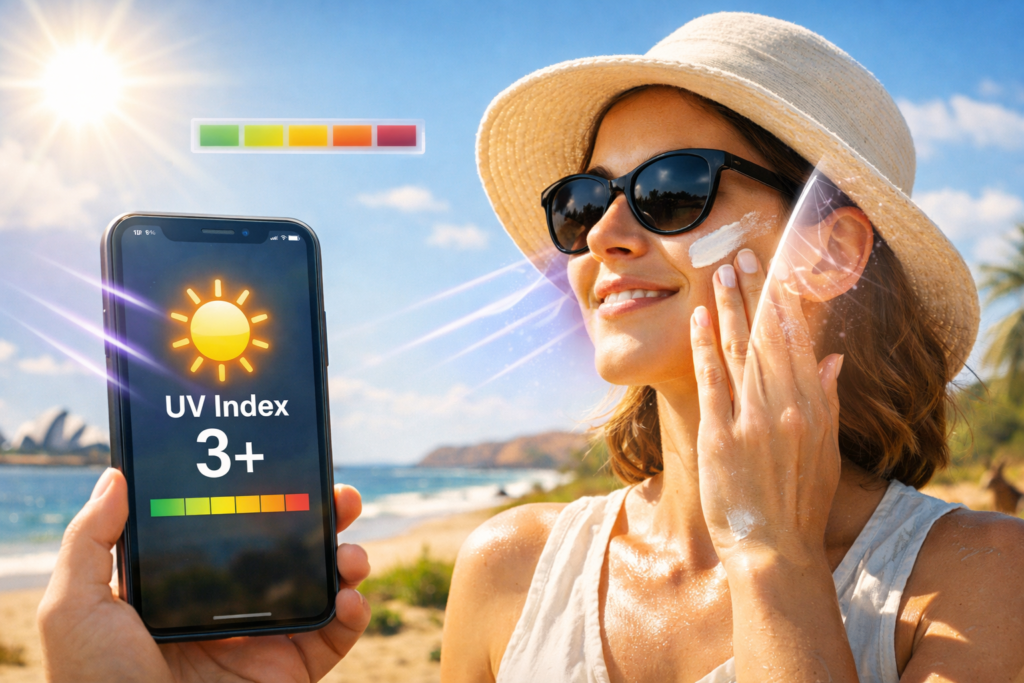
If you have ever glanced at a weather app and noticed the words “UV 3+ Apply Sunscreen,” you may have wondered what that small number actually means for your skin. In Australia, that alert is not just a routine reminder. It is a signal backed by medical research, issued to protect you from one of the most skin-damaging environments on the planet. Australia records some of the highest UV radiation levels in the world, and understanding what UV 3 means, why it matters, and how to respond to it could genuinely protect your skin for decades to come.
What Is the UV Index?
The UV Index is a standard international scale that measures the intensity of ultraviolet radiation reaching the Earth’s surface at a particular location and time. It was developed in collaboration with the World Health Organization and gives you a simple number to help guide your sun protection decisions throughout the day.
The scale runs from 0 to 11 and beyond, with each level reflecting a measurable increase in the potential for skin damage. A reading of 0 to 2 is considered low, meaning the risk is minimal for most people. From 3 to 5 it becomes moderate, 6 to 7 is classified as high, 8 to 10 is very high, and anything at 11 or above is considered extreme.
The critical point in Australia is that reaching level 3 is the threshold at which sun protection becomes necessary. This is the level at which UV radiation is strong enough to begin damaging your skin cells, regardless of whether the day feels hot or cool, sunny or overcast.
Why Australia Is Different
Most countries experience UV levels high enough to require sun protection mainly during peak summer months or during midday hours in warm weather. Australia is different in two important ways: geography and intensity.
Because of a combination of high sun angles, relatively clear skies, and a thinner ozone layer, UV radiation in Australia is particularly intense. In summer, the UV Index regularly exceeds 12 and can reach 16 or 17 in northern regions like Queensland and the Northern Territory. Even on a mild winter’s day in Sydney or Brisbane, the index can still sit comfortably at 3 or above for several hours around midday.
In fact, for most of Queensland, Western Australia, and the Northern Territory, the UV Index stays at 3 or above every single day of the year. Only cities like Hobart and Melbourne, in the cooler south, see average maximum UV levels drop below 3 during winter. This means that for the majority of Australians, sun protection is not a seasonal habit but a year-round daily necessity.
What UV Radiation Actually Does to Your Skin
To understand why UV 3 is taken so seriously, it helps to know what ultraviolet radiation does to the skin at a cellular level. There are two types of UV radiation that reach the Earth’s surface: UVA and UVB.
UVB rays have shorter wavelengths and higher energy. They affect the outer layers of the skin and are the primary cause of sunburn. More critically, they cause direct DNA damage in skin cells, which is the main driver of skin cancers including melanoma. UVB levels fluctuate significantly across seasons and are strongest during summer midday hours.
UVA rays, on the other hand, have longer wavelengths and penetrate much more deeply into the skin. They are largely responsible for premature ageing, including wrinkles, fine lines, and loss of skin elasticity. UVA also contributes to skin cancer. Unlike UVB, UVA radiation is present at relatively consistent levels throughout the year and can penetrate car windows and light cloud cover. It is estimated that UVA accounts for around 95 percent of all UV radiation reaching the Earth’s surface.
Both types accumulate damage over time. Even short, repeated exposures that do not result in visible sunburn add to your lifetime total of UV damage and raise your risk of developing skin cancer. Research has shown that just 15 minutes of unprotected exposure when the UV Index is 3 or above is enough to begin causing cellular damage in the skin.
What the “UV 3+ Sunscreen” Warning Actually Means
When your weather app or the Bureau of Meteorology issues a sun protection alert at UV 3, it is drawing on official guidance from multiple Australian health authorities, including Cancer Council Australia, the Australian Radiation Protection and Nuclear Safety Agency (ARPANSA), and SunSmart. These bodies have a unified position: whenever the UV Index is forecast to reach 3 or above, sun protection measures should be applied before going outdoors.
This applies regardless of the season, the temperature, or your personal skin tone. UV radiation is invisible and odourless. You cannot feel it the way you feel heat, and you do not need to feel hot or see bright sunshine for it to be damaging your skin. A cool autumn morning with thin cloud cover can still have a UV Index of 4 or 5, particularly between 10 am and 4 pm, which is the peak window for UV intensity.
The warning is not about preventing an immediate sunburn, although that risk is very real. It is about protecting your skin from cumulative damage that, over years and decades, increases the risk of melanoma and other skin cancers. Australia already has one of the highest rates of skin cancer in the world, with UV radiation responsible for more than 95 percent of all cases.
How to Protect Your Skin When UV Is 3 or Above
The Australian and New Zealand approach to sun protection is built around a five-step strategy called Slip, Slop, Slap, Seek, and Slide. Each step addresses a different form of protection, and the evidence consistently shows that combining several of these measures is far more effective than relying on sunscreen alone.
Slop: Choosing and Using Sunscreen Correctly
Sunscreen is the most widely discussed form of sun protection, but it is also the most commonly misused. Australian guidelines recommend using a broad-spectrum sunscreen with an SPF of 50 or SPF 50+ on days when the UV Index is forecast to reach 3 or above. Broad-spectrum coverage means the product filters both UVA and UVB radiation, not just one type.
SPF, or Sun Protection Factor, tells you how much protection the product provides against UVB radiation. SPF 30 filters approximately 96.7 percent of UVB rays, while SPF 50 filters around 98 percent. The difference might sound small, but over years of daily use it adds up. SPF 50+ is the maximum rating allowed under the Australian Standard for sunscreens, and it is what both Cancer Council Australia and ARPANSA recommend.
Water resistance is another important factor. Australian regulations allow sunscreens to be labelled as water-resistant for up to 40 minutes or 80 minutes, but no sunscreen is waterproof. After swimming, towel drying, or heavy sweating, you need to reapply.
Timing and quantity matter enormously. Sunscreen should be applied 20 minutes before you go outside so it has time to bind properly to the skin. The average adult needs around 35 ml for a full body application, which works out to roughly one teaspoon for each arm, each leg, the face, the front of the body, and the back. Most people apply far less than this, which significantly reduces the level of protection they receive.
Reapplication every two hours is non-negotiable on active days. Most sunscreens degrade with sun exposure and physical activity, so a single morning application is not sufficient if you are outdoors for several hours.
Slip: Clothing as Your First Line of Defence
Well-designed sun-protective clothing can provide more consistent coverage than sunscreen because it does not wear off, does not need reapplying, and does not depend on even application. Loose-fitting long-sleeved tops and full-length pants in tightly woven fabrics provide substantial UV protection. Clothing with an Ultraviolet Protection Factor (UPF) rating offers even more reliable coverage.
For everyday activities such as walking, gardening, or outdoor work, protective clothing is the single most effective barrier you can use.
Slap: Hats for Face, Neck, and Ears
A broad-brimmed hat with a brim of at least 7.5 centimetres provides meaningful protection for your face, the back of your neck, and your ears, three areas that receive intense UV exposure and where skin cancers are common. Baseball caps and visors leave the neck and ears largely unprotected and are far less effective.
Seek: Using Shade Wisely
Staying in the shade during peak UV hours, generally between 10 am and 4 pm, significantly reduces your exposure. However, shade is not a complete solution on its own. Reflected UV from surfaces like concrete, water, sand, and even some grass can reach your skin even when you are not in direct sunlight. Indirect UV exposure is real and should not be overlooked.
Slide: Protecting Your Eyes
UV radiation damages the eyes as well as the skin and is linked to cataracts and ocular melanoma. Sunglasses that meet Australian standard AS/NZS 1067 provide reliable UV protection. Wraparound styles offer the broadest coverage.
Checking the UV Index Daily
One of the most practical habits you can build is checking the UV Index before you leave home each morning. Several free tools make this straightforward. The SunSmart app, produced by Cancer Council Victoria, provides real-time and forecast UV levels for your location along with advice on when protection is needed. The Bureau of Meteorology’s BOM Weather app and website also display the daily UV Index. ARPANSA publishes real-time UV charts for all of Australia’s capital cities.
Checking the index takes seconds and removes the guesswork entirely. On days when the maximum UV is forecast below 3, most people can go outdoors without intensive sun protection measures. On days when it is 3 or above, the five-step routine applies.
Common Misconceptions About UV Protection
One of the most persistent misunderstandings is that UV protection is only necessary when it is hot or when the sky is clear. Temperature and UV intensity are not directly related. UV radiation comes from the sun’s energy output at specific wavelengths, not from heat. A crisp, overcast winter’s day in Sydney can still have a UV Index of 3 or above at midday. Thin cloud provides very little reduction in UV levels, and even in shade, reflected UV can cause damage.
Another common mistake is thinking that a single application of sunscreen in the morning is sufficient for a full day outdoors. It is not. Sunscreen must be reapplied every two hours and after any activity that removes it from the skin.
A third misconception involves darker skin tones. While people with naturally darker skin have more melanin, which does provide some protective effect, UV radiation still causes cumulative DNA damage regardless of skin tone. No skin type is immune to the effects of UV exposure, and sun protection is recommended for everyone.
Skincare Beyond Sunscreen
On a skincare level, consistent sunscreen use does far more than prevent cancer. Daily broad-spectrum protection significantly slows the visible signs of skin ageing. It is estimated that as much as 80 percent of premature facial ageing, including wrinkles, fine lines, uneven pigmentation, and loss of skin firmness, is caused by cumulative UV exposure over a lifetime. Incorporating SPF 50+ into your morning skincare routine as a final step before leaving the house is one of the most evidence-based anti-ageing decisions you can make.
Many modern formulations are lightweight, non-greasy, and cosmetically elegant, making them suitable for all skin types and easy to wear every day. Tinted options offer a practical way to combine SPF with a finishing effect for the face. Look for an Aust L registration number on the label, which confirms that the product has been approved by the Therapeutic Goods Administration (TGA) and meets Australian safety and efficacy standards.