If you have ever stood in a pharmacy aisle staring at sunscreen bottles wondering what the numbers actually mean, you are not alone. SPF stands for Sun Protection Factor, and despite appearing on millions of products, it is one of the most misunderstood numbers in skincare.
The SPF indicates how effective a sunscreen is against sunburn. SPF is measured on human skin in a laboratory. Scientists measure how long it takes for intense ultraviolet radiation to burn skin with the sunscreen applied compared to bare skin. For example, if skin protected with a sunscreen takes 300 seconds to burn but bare skin burns in 10 seconds, the sunscreen’s SPF is 30.
So SPF is essentially a multiplier of your natural burn time. The higher the number, the longer you are theoretically protected. But as you will see, higher numbers do not mean dramatically more protection, and understanding why is the whole point of this article.
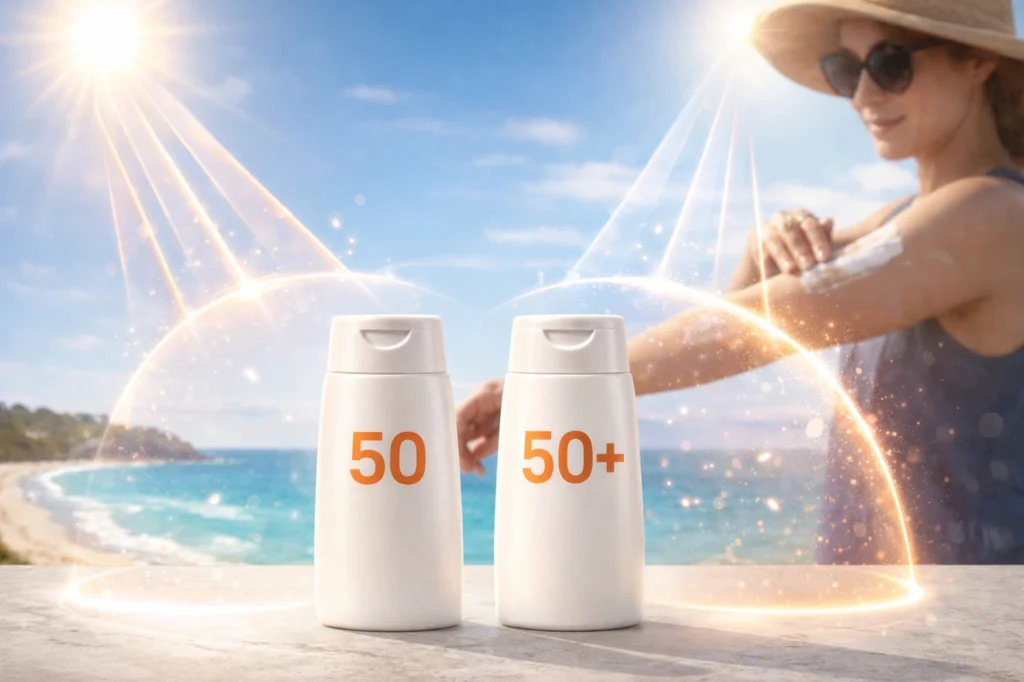
The Difference Between SPF 50 and SPF 50+
This is where many Australians get confused. SPF 50 and SPF 50+ are not the same thing, even though they look almost identical on a label.
The plus sign associated with the SPF number means that the SPF rating is higher than the number. The plus sign can only be used for sunscreen products with SPF 50. Products labelled SPF 50+ have an SPF of 60 or more and provide a very high level of protection.
In plain terms, a product labelled SPF 50 has been tested and confirmed to reach an SPF of at least 50 but not yet 60. A product labelled SPF 50+ has been tested and confirmed to reach an SPF of at least 60, possibly higher, but the label is not permitted to show that higher number. The plus sign is a signal to the consumer that the product exceeds the 50 threshold without advertising the precise figure.
To claim that a sunscreen is SPF 50+, the average SPF from testing must be at least 60. The SPF is the mean average of the SPF from each valid test, which must be performed on at least 10 different people.
So when you pick up an SPF 50+ product in Australia, you are getting something that has genuinely tested above 60, which is more protective than a plain SPF 50 product. The difference in real-world terms is small but meaningful, and Australian regulations make that distinction very clear.
Why You Will Never See SPF 80 or SPF 100 in Australia
If you have travelled to the United States, Japan, or South Korea, you may have seen sunscreens labelled SPF 70, SPF 85, or even SPF 100. Australia deliberately does not allow this, and the reason comes down to a very sensible piece of consumer protection.
The Australian Standard for sunscreens limits the maximum protection claimed on the labelling of sunscreen products to SPF 50+. Sunscreen manufacturers are also unable to claim the terms sunblock, waterproof, and sweat proof as these terms are considered to be potentially misleading.
The reason for capping labels at 50+ is rooted in how protection actually scales with SPF numbers. When applied correctly, an SPF 30 sunscreen filters approximately 97% of UVB rays, while an SPF 50 sunscreen filters approximately 98%. The difference in protection between an SPF of 30 and 50 is small, and this difference becomes even smaller as the SPF value increases.
Think about what that means in practice. Going from SPF 50 to SPF 100 would only move you from filtering 98% of UVB rays to filtering roughly 99%. That is a real but marginal gain. Regulators believe that advertising ultra-high SPF numbers can give a false sense of security, since an SPF 100 is not actually twice as protective as SPF 50. By capping claims at 50+, Australian authorities keep expectations realistic and encourage people not to rely on any single product as a magic shield.
In some other countries like the US, you might see seemingly arbitrary SPF numbers like 70 or 85. These distinct high numbers are a direct result of stringent laboratory testing, precisely quantifying the product’s efficacy. Australia’s approach avoids giving a false impression that an SPF 100 is twice as good as SPF 50.
This is a deliberate policy choice. The Australian government does not want people to see SPF 100 on a bottle and then skip reapplication because they assume they are fully covered. The emphasis is on correct application and regular reapplication, not on chasing an ever-higher number.
How Australia Regulates Sunscreen: Stricter Than You Think
Australia treats sunscreen very differently from most countries. Primary sunscreens, which are products represented as being primarily for protecting the skin from UV radiation, must generally be in the Australian Register of Therapeutic Goods before they can be legally supplied or sold in Australia.
This is significant. In most countries, sunscreen is classified as a cosmetic. In Australia, it is classified as a medicine. The Therapeutic Goods Administration is the Australian government body responsible for regulating medicines and other products. By treating primary sunscreens as therapeutic goods, Australia ensures that products designed for sun UV protection are held to a higher standard.
Every TGA-approved sunscreen carries an AUST L number on the packaging. This number means the sunscreen has been formulated to comply with regulations and has undergone clinical studies proven to be safe and effective at protecting from sun damage. If a product does not have an AUST L number, it has not been approved as a therapeutic sunscreen, regardless of what SPF claim it makes on the label.
A sunscreen’s SPF number cannot appear on its label until the product passes controlled testing and verification. Manufacturers must submit all data to the TGA for review before gaining market approval. This regulatory gatekeeping prevents inflated SPF claims and ensures transparency from production to sale.
Testing also continues after a product reaches shelves. Even after approval, sunscreens are subject to random post-market testing. The TGA can request supporting data from any approved sponsor at any time.
Also Read: Sunscreen Pilling Fix
The SPF Categories on Australian Labels
Australia uses a specific set of SPF categories, and only certain numbers are permitted on labels. The category descriptions based on SPF are as follows: SPF 4 to 14 is considered low protection, SPF 15 to 29 is medium or moderate protection, SPF 30 to 59 is high protection, and SPF 60 or higher is labelled as SPF 50+ and described as very high protection.
Only certain SPF numbers are allowed for therapeutic sunscreens: 4, 6, 8, 10, 15, 20, 25, 30, 40, 50, and 50+. You will never see an Australian-approved therapeutic sunscreen labelled SPF 45 or SPF 35, because those numbers are simply not permitted categories under the Australian standard.
This system is clean and easy to navigate. When you see SPF 50+ on an Australian product, you know exactly what it means, what it has been tested to, and that it sits at the very top of the protection scale the country allows.
What Broad Spectrum Means and Why It Matters
SPF alone does not tell the whole story of a sunscreen’s protection. The number on the front of the bottle primarily refers to protection against UVB rays, which are the rays that cause sunburn. But there is a second type of UV radiation called UVA, which causes longer-term skin damage, premature ageing, and also contributes to skin cancer risk.
The term broad spectrum means that a sunscreen protects against both the sun’s ultraviolet A rays and ultraviolet B rays. UVA is the radiation that is believed to be the main cause of long-term damage. Sunscreens that are not broad spectrum only protect against UVB radiation.
In Australia, a sunscreen can only make a broad-spectrum claim if it passes specific testing under the Australian Sunscreen Standard. This means when you see “broad spectrum SPF 50+” on an Australian product, it is a genuinely verified claim backed by testing, not just a marketing phrase.
The 2025 SPF Testing Scandal: What Consumers Should Know
In 2025, Australian sunscreen regulation came under significant public scrutiny when consumer advocacy group CHOICE published a report that shook confidence in many popular products. CHOICE published a report in June 2025 which found that 16 sunscreens of the 20 they tested did not meet their claimed SPF 50+ ratings. One of the most striking failures was Ultra Violette Lean Screen SPF 50+, which tested at just SPF 4.
The TGA found that the base formulation used by multiple affected sunscreens was unlikely to have an SPF greater than 21. Preliminary testing of specific products using that base formulation indicated that the SPF value may, for at least some of the products, be as low as SPF 4.
The TGA investigated and found that a significant number of these products had relied on testing from a single laboratory, Princeton Consumer Research Corp in the United Kingdom, whose results the TGA found unreliable. The TGA acknowledges that variability in SPF test results is not uncommon, but emphasises that swift action must be taken where inconsistencies indicate a product may not provide safe levels of sun protection. There are more than 900 sunscreens approved for sale in Australia by the TGA.
The takeaway for consumers is not to abandon sunscreen but to look for products with verified TGA approval and, where possible, choose brands that publish their testing data transparently. The system caught the failures and acted on them, though the episode exposed the need for more robust routine testing beyond initial product approval.
Practical Tips: Choosing and Reading a Sunscreen Label in Australia
When you pick up a sunscreen in Australia, here is what to look for on the label to make sure you are getting genuine protection.
Look for the AUST L number. This confirms the product has been through the TGA’s approval process and meets the Australian Therapeutic Goods standard. Without it, any SPF claim on the label is unverified.
Choose broad spectrum SPF 50 or SPF 50+. These are the highest protection categories available in Australia. SPF 50 and SPF 50+ sunscreens will provide excellent protection as long as they are applied properly.
Check for water resistance if you plan to swim or sweat. Australian standards allow claims of up to four hours of water resistance, but only if the product has passed specific immersion testing to back that claim.
Do not be swayed by the absence of very high SPF numbers. If you travel overseas and see SPF 70 or SPF 100, those products are not dramatically better than an Australian SPF 50+. The difference is in the labelling system, not in meaningfully superior protection.