Australia has one of the harshest sun environments on the planet. Australia experiences some of the highest levels of UV radiation in the world because of its geographical location and its many clear, blue-sky days. This is not just a summer problem. UV rays are present year round, and they can damage skin even on cool or overcast days.
The health stakes are high. Australia has the highest rates of skin cancer in the world, and around 2,000 people die from skin cancer each year. There were over a million treatments for squamous and basal cell carcinoma skin cancers in 2023, which works out to more than 100 skin cancer treatments every hour.
Despite this, sunscreen habits across the country remain inconsistent. Only two in five Australians used sunscreen on most days during late spring and summer when daily sunscreen use is recommended. Men were less likely to use sunscreen regularly at 27 percent, compared to 50.7 percent of women.
For people who wear makeup, the challenge goes one step further. Applying sunscreen in the morning is just the starting point. The real difficulty is keeping that protection going throughout the day without disturbing a carefully applied base. That is exactly what this guide is here to solve.
How Long Does Sunscreen Last on Your Skin?
Before getting into methods and tools, it is worth understanding why reapplication is necessary in the first place. Sunscreen does not stay effective all day once you put it on.
Australian regulatory guidelines state that sunscreen should be applied generously to all exposed areas twenty minutes before sun exposure, reapplied every two hours or more often when sweating, and reapplied after swimming or towelling off. Products are also not permitted to claim “all day protection” that implies reapplication is unnecessary.
Sunscreen breaks down at a microlevel over time, allowing more damaging UV rays to reach the skin. This happens whether you are indoors near a window or outside at a lunch event. The breakdown is gradual and invisible, which makes it easy to overlook.
There is also a common myth worth clearing up. Reapplication is about time elapsed, not about how much sun you have been standing in. Reapplying sunscreen is recommended after two hours of time, not two hours of total sun exposure. Sunscreen wears off whether you are in the sun or not.
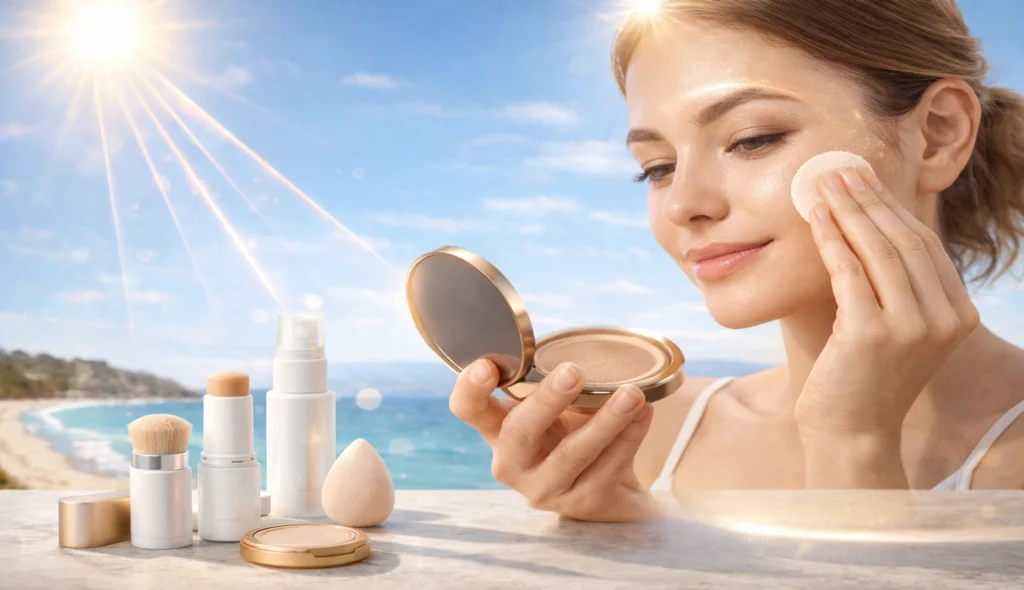
Getting Your Morning Application Right First
Effective reapplication during the day depends on starting with a solid morning base. You need to apply sunscreen before your makeup, using approximately two finger lengths of product for the face and neck. Four in five Australians do not apply enough sunscreen, so using the right amount from the start is important.
Sunscreen should always be applied as the last step of your skincare routine, before makeup. The reason is that none of us wear a thick enough layer of makeup to protect our skin from the sun’s rays. Makeup with SPF should be considered a bonus rather than solid sun protection.
Choose a lightweight, broad-spectrum SPF 50 or SPF 50+ product. In Australia, all sunscreens sold are regulated by the Therapeutic Goods Administration, so any product you find at a pharmacy or supermarket meets strict safety and efficacy requirements. Allow it to absorb for a few minutes before applying your base.
The Four Best Ways to Reapply Sunscreen Over Makeup
The Sponge or Cushion Puff Method
This is the technique most recommended by Australian skincare experts and cosmetic chemists, and it consistently delivers the best results. It allows you to apply a proper amount of sunscreen without dragging your foundation off your skin.
The optimal reapplication tool is a low absorbency beauty sponge. The very small fibres hold onto and apply creams and liquids without absorbing them, and this also means the sponge will not absorb or transfer the makeup already on your face.
The technique itself is straightforward. Apply a small amount of sunscreen to the sponge, then stamp it onto your skin in gentle pressing motions. Keep layering until you have reapplied the correct amount according to the packaging. Avoid dragging the sponge across your face to keep your makeup intact. Go slowly and apply in light layers. Do not dampen your sponge, as this will dilute your SPF protection. Use a velvet sponge or a dry sponge for best results.
Australian cosmetic chemist and science educator Dr Michelle Wong recommends a similar approach. She suggests using a cushion puff because it is portable and does not soak up much sunscreen.
You may find your blush or contour looks slightly less vivid after reapplying. While your foundation will stay intact, you may lose some contour, which is easily fixed by reapplying it over the top of your sunscreen. A quick dusting of colour on top takes seconds and is a small price to pay for proper sun protection.
For moderate sun exposure on a typical day, such as heading out for a lunchtime walk, the recommended approach is to reapply right before going out, using roughly a quarter teaspoon of sunscreen patted on with a cushion puff.
The Spray or Mist Method
SPF mists and sprays have become very popular in Australia over recent years, and they are genuinely useful for people who need something quick and portable. They are especially good for topping up when you are wearing a full face of makeup and do not want to reach for a sponge.
Spray formulas keep makeup intact while protecting against sun damage. When using a spray, keep your mouth closed, stand away from wind to avoid the product dispersing into the air rather than landing on your face, and do a few passes to cover the entire face and ears.
To ensure even application and protection, spray generously every two hours with eyes and mouth closed. Many Australian brands such as Naked Sundays have developed SPF 50+ face mist products specifically designed to layer over makeup without causing smudging or patchiness.
The main limitation with sprays is coverage consistency. Some dermatologists note that mists can give uneven protection if not applied generously enough or if the user is standing in a breeze. For this reason, sprays work best as a supplement to a thorough morning application rather than as a standalone reapplication method during high UV exposure such as a beach day or outdoor event.
The Sunscreen Stick Method
Sunscreen sticks are compact, mess-free, and very easy to carry in a handbag or bag pocket. They are especially useful for targeting specific high-exposure areas such as the nose, forehead, cheekbones, tops of the ears, and the back of the neck.
Sunscreen sticks are one of the easiest ways to reapply sunscreen. You have total control over how much product you are applying and exactly where you are applying it. If you are spending the day at the beach or running around all day, this is a great way to reapply a generous amount on the go.
The key limitation of sticks is that they suit lighter makeup best. If you have a full face on, there may be some transfer. For people wearing a light base, a tinted moisturiser, or minimal coverage, a stick is an excellent and practical option. Apply with light strokes rather than pressing hard, and blend gently with a clean fingertip or dry sponge afterward to work the product into the skin evenly.
The Cushion Compact Method
Cushion sunscreens combine the ease of a pressed compact with the feel of a liquid formula. They originated in South Korea, where daily SPF reapplication is a deeply embedded part of skincare culture, and they have gained a strong and growing following across Australia.
A hydrating mineral sunscreen in a cushion compact is designed for effortless SPF reapplication throughout the day, even over makeup, while providing lasting hydration and shielding the skin from harmful UV rays.
The application method uses the same pressing technique as the sponge method. Press the puff into the cushion, then pat it gently across the face in sections. Most cushion compacts come with a built-in mirror, making them very practical for on-the-go touch-ups at your desk, in the car, or between meetings. Many cushion sunscreens also carry a light tint, which means they can refresh your base at the same time as they top up your protection.
The sponge applicator in a cushion compact means you are applying sunscreen evenly across your face without ruining your makeup.
One important note for Australian buyers: Australia has some of the strictest sunscreen testing and regulations in the world, making it important to use products that meet local TGA standards to ensure adequate protection. Some cushion products imported from Korea or other countries may not be tested to Australian standards, so always check the label before relying on them for sun protection.
What About SPF Powder? Read This Before You Rely on It
Powder sunscreens are widely marketed as a convenient touch-up tool and they do have a role to play. However, they come with a meaningful limitation.
Powder SPFs have not been proven to be as reliable as other forms of sunscreen. They can provide patchy coverage, making it difficult to achieve consistent protection. For the best protection, it is better to use creams, mists, or sticks.
Relying on mineral powders alone is not recommended because there is no reliable way of knowing whether you have applied enough. That said, they work well as a touch-up tool and as a more protective alternative to ordinary blotting paper when managing shine throughout the day.
Think of powder SPF as a helpful bonus layer, not a replacement for the methods described above.
A Simple Routine Based on Your Day
Not every day carries the same UV risk, and your reapplication routine can reflect that sensibly. On days spent mostly indoors moving between a car and an office, a thorough morning application combined with shade and a hat may cover you adequately. On days that involve outdoor lunch breaks, afternoon errands, sport, or time at a beach or park, reapplying every two hours using a spray, sponge, or cushion method is essential.
Cancer Council recommends applying SPF 50 or higher broad-spectrum, water-resistant sunscreen and reapplying every two hours, especially after swimming, sweating, and towel-drying. Even on cool, cloudy days the UV can still be strong, so always check the UV Index before heading outside.
The free SunSmart app, developed by Cancer Council, lets you check the UV index for your specific location throughout the day. When it reaches 3 or above, sun protection is needed regardless of how the sky looks or how mild the temperature feels.